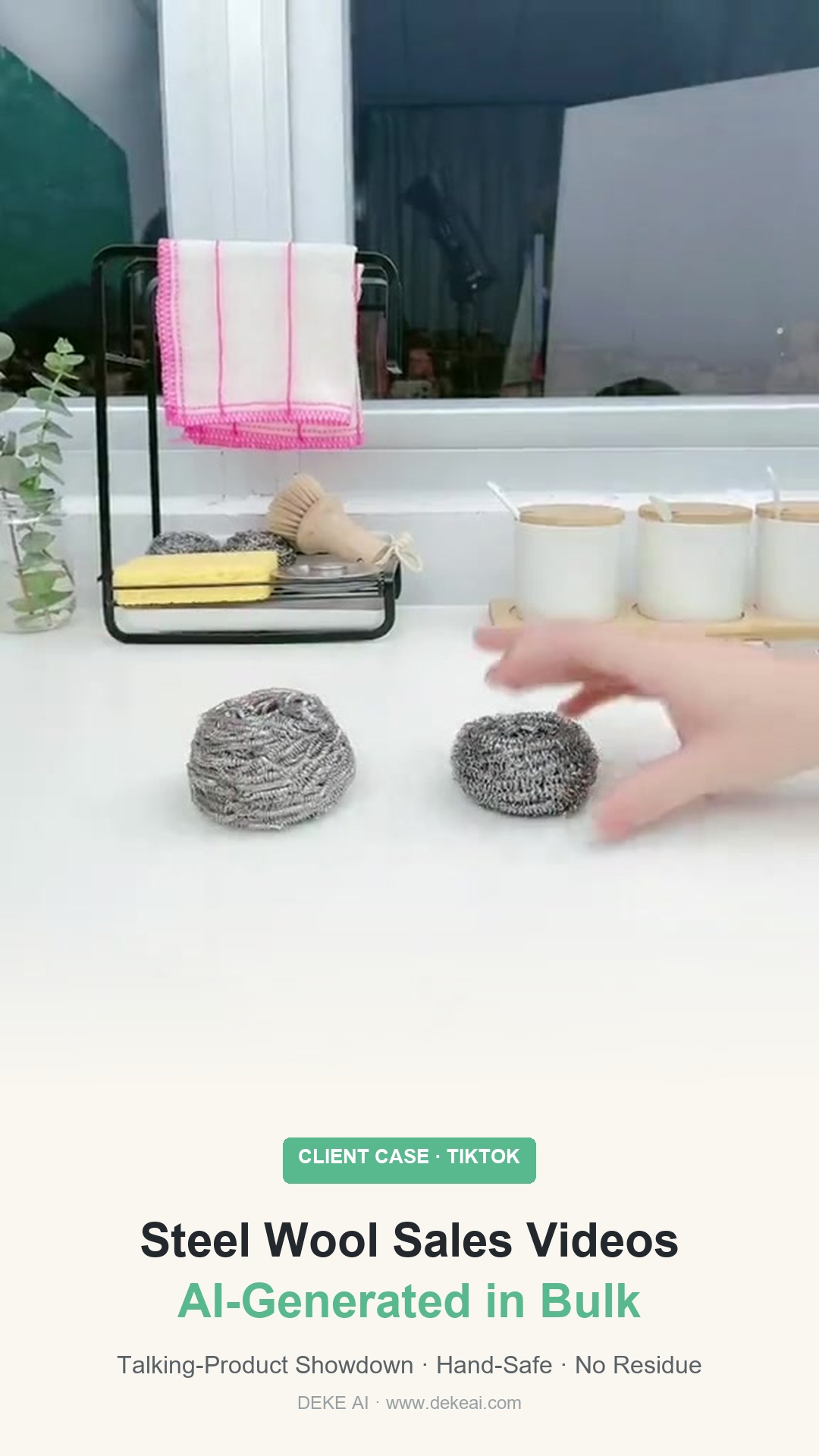
Customer background and pain points: Steel wool scrubbers "all look the same," and whether they work well can only be conveyed by word of mouth
Customer Profile: A certain home and household goods merchant, mainly focused on kitchen cleaning daily necessities (steel wool scrubbers, scouring pads, cleaning brushes, etc.), following a "low order value, high repurchase" daily fast-moving consumer goods route, with Douyin and other short video channels as the main battleground. The target audience is the 30–55 housework main force and kitchen product repurchase users, whose decisions rely on the intuitive feeling of "looks clean, doesn't tire your hands," and who are most sensitive to practical selling points like "durable, won't hurt hands, won't shed residue."
Core Pain Points: Severe homogenization, selling points can't convey differentiation. Steel wool scrubbers look almost identical, and ordinary versions and 304 versions are hard to tell apart by eye. Real differences like "food-grade 304," "won't rust," and "won't hurt hands" simply can't be explained clearly with one main image and one line of detail page copy, leaving users to only compare prices. Materials are consumed quickly, and per-piece shooting costs are high. Kitchen cleaning products have fast new launch and volume deployment rhythms, and each piece requires "hands on camera + live kitchen shoot + pot-scrubbing process." From set design to shooting to editing, the cost per piece runs into several hundred yuan, making volume deployment unaffordable. Selling points are scattered, with no persuasion chain. "Soft and stretch-resistant without deforming," "scrubs pots clean without hurting hands or pots," and "won't shed residue or rust" are actually strong points, but they're scattered across packaging and customer service scripts, never organized into content that "explains the problem thoroughly in one video." Content and conversion are disconnected. After the video is done, ad delivery, product links, and scripts still need to be prepared separately, and there's a missing closing link between seeding and ordering, so good content can't retain viewers.
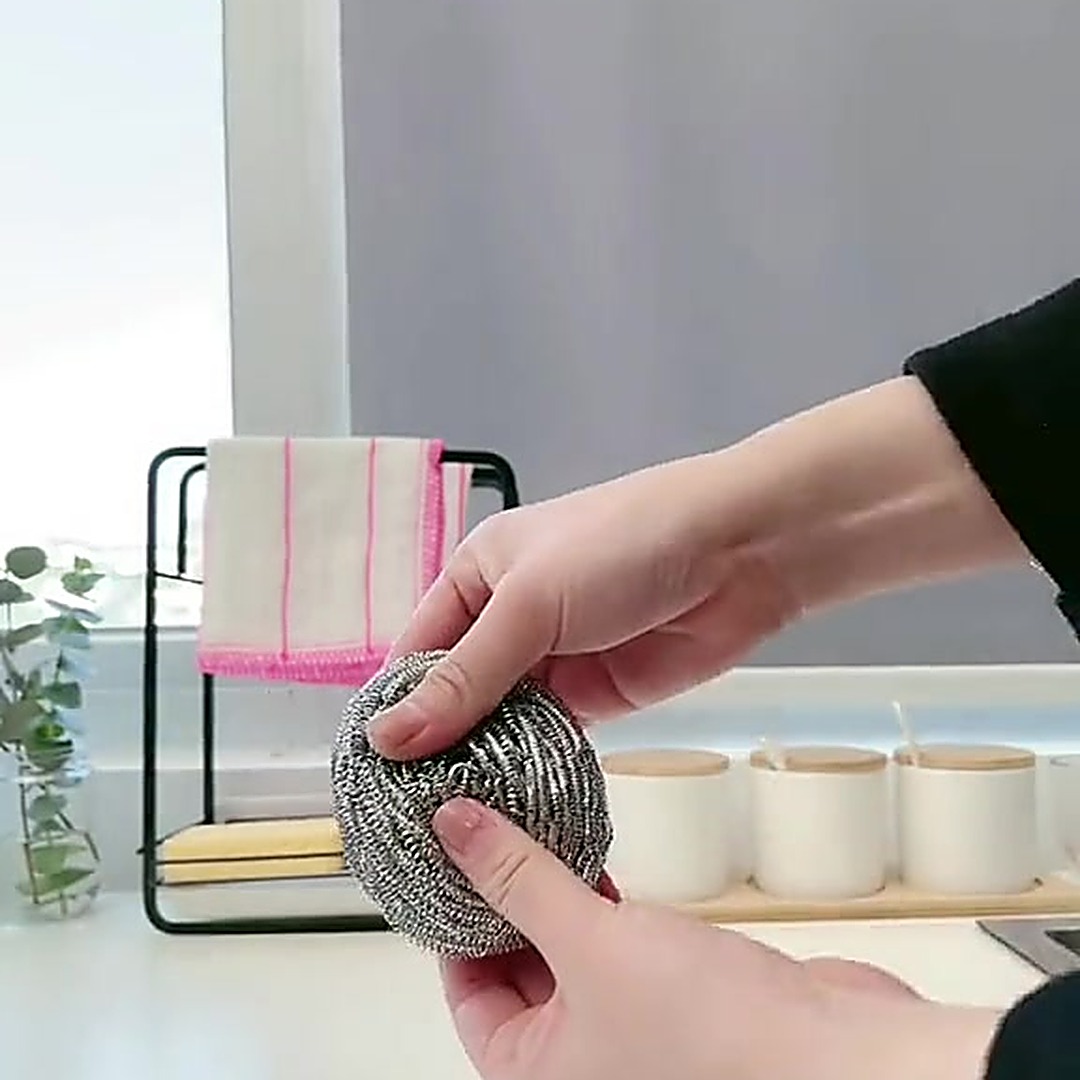
Solution: 19 seconds let two steel wool scrubbers "talk back at each other," driving the comparison straight into users' hearts
Precise Content Generation: Operators enter steel wool scrubber product information into DKS (material/specifications, core selling points, target audience, usage scenarios), and the system generates a short video script structured as "first-person anthropomorphic dialogue," producing a single vertical video of about 19.5 seconds: opening with two steel wool scrubbers standing side by side on a white countertop to set up the "comparison" expectation, then the ordinary scrubber confesses first — "I deform with one pull" and "my hands hurt and turn black when I scrub pots"; the 304 scrubber proves itself point by point — "I'm soft and stretch-resistant without deforming," "I scrub pots clean without hurting hands or pots," and "I don't shed residue or rust when scrubbing"; finally the ordinary one closes with a fun line, "Okay, you win," turning product comparison into a playful back-and-forth mini dialogue, with each subtitle corresponding to one visual.
Script Model Switching: Built-in multiple script templates, switchable at any time based on campaign objectives, enabling multi-angle volume deployment for the same product without repetition.
Mass Production and Distribution: Enter information once and batch-produce videos by template, export in 9:16 vertical format, and directly deploy to TikTok; generate 20 pieces of material from different angles for the same product and launch them simultaneously for testing. The selling point library and script structure can be reused across the entire kitchen cleaning category — scouring pads, cleaning brushes, dishcloths, and more — by simply swapping the category, with content ready on the day of new product launch.
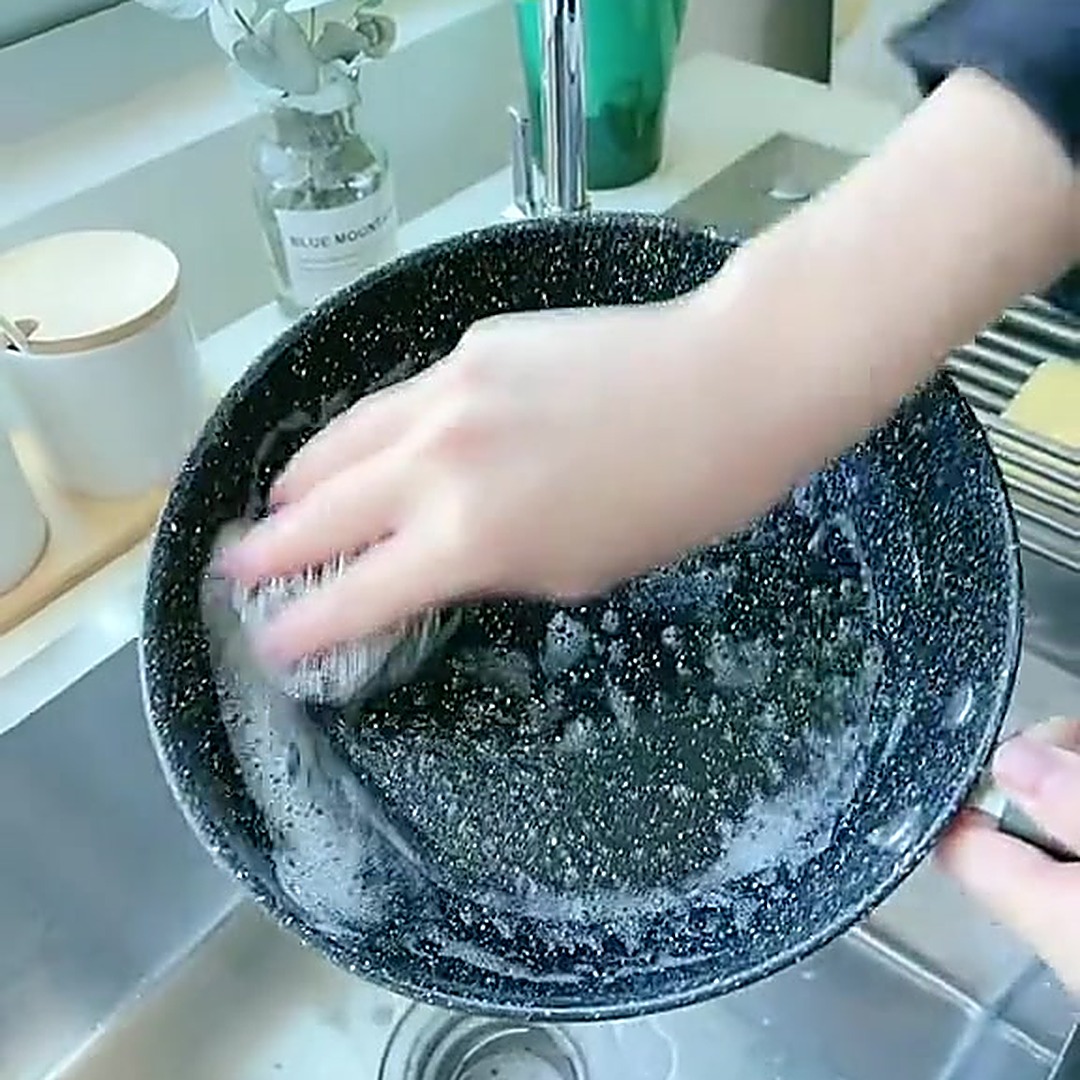
Implementation results: From "waiting for external shoot schedules" to "enter information and get videos, deploy materials the same day"
Capacity Improvement: Material output goes from "waiting days for external shoots" to "enter information and get videos, usable the same day," with new launches fully stocked with materials for testing on day one; 20 pieces generated per batch, with per-piece material cost reduced to one-third of the original, eliminating the shooting organization costs of set design and hands on camera.
Content Precision: Selling points go from being scattered on packaging to a complete persuasion chain within 19 seconds covering "set up the comparison — ordinary version confesses — 304 version proves itself — fun ending" without missing a beat, with stretch resistance, hand protection, no residue shedding, and no rusting broken down item by item and fully covered; script angles (anthropomorphic / real test / comparison / scenario) are divided by template, allowing performance data to be directly attributed to script angles.
Customer Acquisition Loop: Batch volume deployment ensures exposure density → anthropomorphic dialogue and real test visuals build trust → direct selling points provide the reason to switch → product links and product cards capture orders, forming a repeatable loop of "new launch — volume deployment — testing — optimization"; operator energy shifts from chasing materials back to product selection and ad delivery itself.